Resolution · June 18, 2026
What is a picture resolution if a 4 by 6 and a 1200 by 1800 file disagree
A client with a 4 by 6 and a 1200 by 1800 file asked what is a picture resolution, because the scanner box promised sharpness.
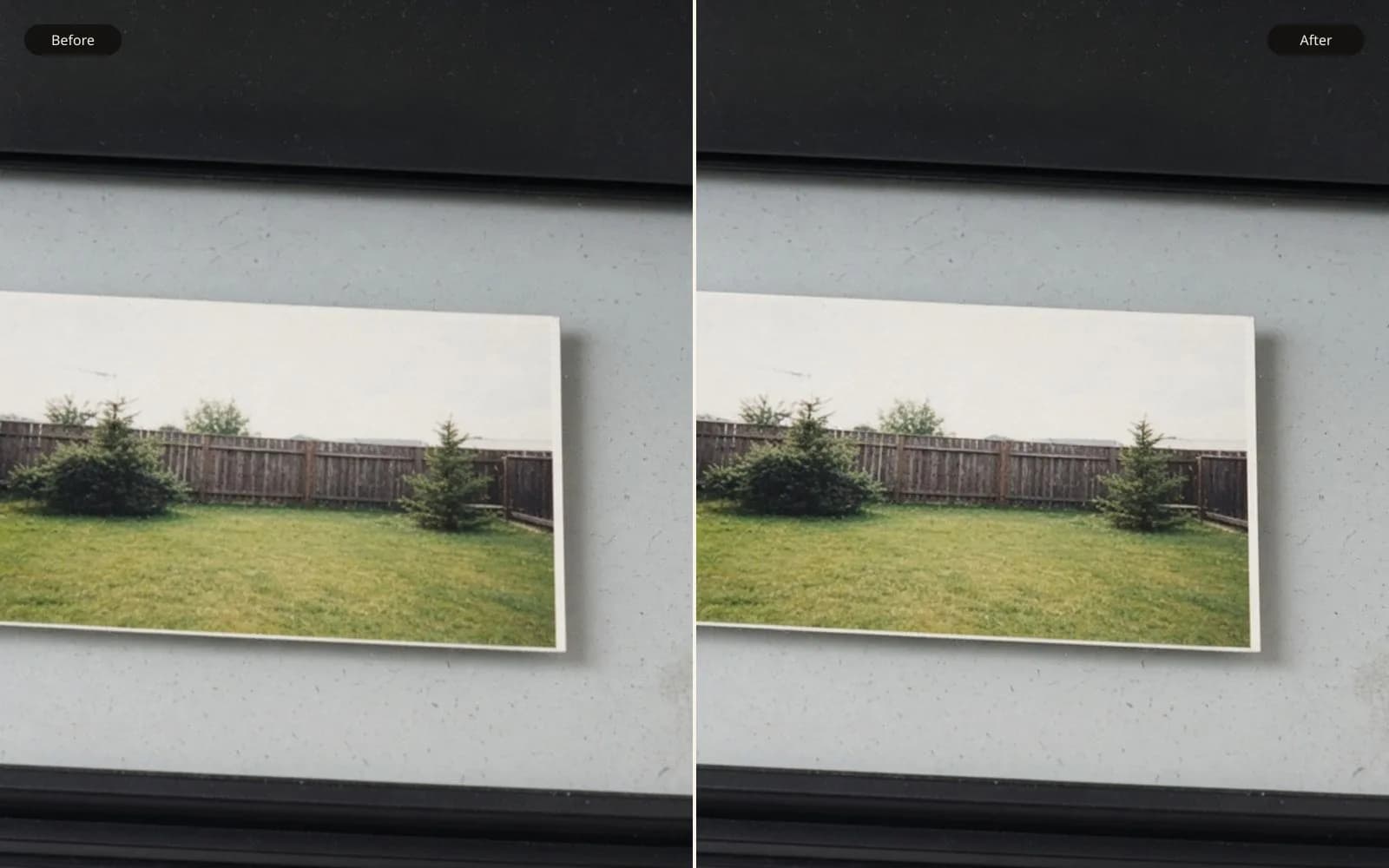
A 4×6 and a 1200×1800 file agree only when you do the division. Open the 4×6 calculator and read the pixels per inch.
She put a 4 by 6 on the kitchen table and asked what is a picture resolution, because the box on the library scanner said 4800 and the picture on her laptop looked soft. The print is her father in 1978, standing by the door of a pickup, a thin white border, a drugstore reprint from a stack she found in a drawer. The file she made is scan-4x6-1200x1800.jpg. It is 1200 by 1800 pixels. She had been told by two websites that 300 means good and that bigger means sharper, and the box had a bigger number than either website. I restore family pictures. This hour was not a repair. It was a translation, with the print in my left hand and the file on the screen so neither number could float free.
TL;DR. The 4 by 6 and the 1200 by 1800 file agree with each other. 1200 divided by 4 is 300, and 1800 divided by 6 is 300. That is a sampling rate of the paper, not a sharpness grade. The scanner's 4800 is what the machine can do, not what this file is and not what this face contains. A 600 scan and a tight high-rate crop of a shirt button showed more paper fiber and the same soft button. An upscale of a tiny version invented a crisper eye. I archived scan-4x6-600.tif and did not invent her father.
Three different things the websites had glued together
I wrote three headings on a piece of paper, because the phrase picture resolution was doing too much work and I wanted it where she could see it fail.
Pixels. The file is a grid. This grid is 1200 across and 1800 down. That is the only size the file has. If a layout program, a website, or a lab asks how big the picture is, and they mean the grid, this is the answer. I can read it without the print in the room. The JPG does not remember the truck.
Mapping. If you also have a physical size, you can say how the grid sits on that size. The print is 4 inches by 6. 1200 divided by 4 is 300. 1800 divided by 6 is 300. So this file is a 300-sample-per-inch record of this print. If she prints the file again at 4 by 6, she is putting the samples back about where the scanner found them. If she prints it at 8 by 12, the same samples spread out, 150 per inch of the new paper. The file did not change. The spread did.
Sharpness. The face, the door handle, the button on the shirt. Whether those edges are crisp. Nothing in the two numbers above measures that. A 1200 by 1800 grid can hold a razor or it can hold a blur, and both files will report the same dimensions. Her father's print is the blur case. I held it under the lamp. The eyes are gentle. The button is a pale disc without a readable hole. The reprint had been soft for decades. The scanner did not do that. A drugstore machine and a small original did, years ago.
What is a picture resolution, if I have to answer in one breath, is usually the pixel grid, sometimes the mapping, and almost never the sharpness people are grieving. She was grieving sharpness and holding a mapping in her hand. The box had offered a third number, a hardware maximum, which is not the grid she had and not the face she wanted. Three honest answers. None of them is "4800, so he should look sharp."
The longer cousin of this split, the one I send when someone is staring at a dialog box and a dpi label, is what is resolution in pictures. How to read the number off a file you did not scan yourself is how to tell image resolution. The dpi word, which the box used, gets its own untangling in how to know my dpi. I am staying at this table. The pickup is the example. The glossary can wait in those notes.
What 300 per inch of this print actually captured
We opened scan-4x6-1200x1800.jpg at 100 percent. On my screen that is a large picture, larger than the print. Already a clue. People expect 100 percent to be a truth window. It is just one pixel per screen pixel. It makes softness easier to see. It does not create it.
His eyes, at that zoom, are smooth brown discs with a single vague highlight. There are no lashes. There were no lashes on the paper either. I had her look at the print with a magnifying glass from the kitchen drawer, the kind meant for splinters. The print does not have lashes. She laughed, a little annoyed at the print, which is the right target.
The button is about 40 pixels across in this file. It is a light circle on a darker shirt, and the edge of the circle fades over four or five pixels. That fade is the reprint. A woven shirt from a sharp negative, scanned at 300 per inch, would show a crisper rim and maybe a thread. We do not have that negative. She has asked her brother. He thinks the envelope was thrown out in a move. Until the envelope appears, the button's fade is the fact.
The border of the print is in the scan, a white strip. I am glad she included it. The strip is a straight edge the scanner did not invent, and it shows the scan is not wildly crooked. About half a degree, which I left alone. Straightening is not resolution. I mention it because she asked if fixing the tilt would "bring up the resolution." It will not. It will make the frame easier to crop.
The JPEG is a bit crunchy in the sky above the truck, quality maybe 8 out of a library preset that wanted a small email. The sky has faint blocks. His face, being soft, hides the blocks better than the sky does. So the file has a second, smaller problem, compression, sitting on top of a faithful scan of a soft print. Re-saving at a higher quality from this JPEG will not remove the blocks that are already baked in. A new scan, saved as TIFF, will avoid a second bake. That is why I wanted to scan it again myself, not because 1200 by 1800 was a shameful grid.
The box, which was advertising a gear
The library scanner's lid has a sticker. Optical resolution 4800 dpi. She photographed the sticker, which I enjoyed, because the sticker is the entire confusion in one object. DPI on a scanner sticker means how many samples the carriage can take along the bed, at the slowest, most ridiculous setting. It is a capability. It is not the resolution of her father. It is not even the setting she used.
She had chosen a preset called Photo. The preset wrote 1200 by 1800, which is 300 per inch of a 4 by 6. That is a sane preset for a reprint you might print again at the same size. It is a bad preset if you wanted to study paper, and it is neither good nor bad with respect to lashes that are not there.
I did not scan the whole print at 4800. Four inches times 4800 is 19200. Six inches times 4800 is 28800. The TIFF would be heavy, slow to open on her laptop, and still soft in the eyes. I have made that file for other clients who insisted. They remember the wait. They do not remember a miracle. Instead I scanned two comparisons that fit in an afternoon.
A whole print at 600, and a button at a show-off rate
scan-4x6-600.tif is 2400 by 3600. That is 600 samples per inch of the same 4 by 6. I set the driver to color photo, unsharp mask off, dust removal off, TIFF. Dust removal on a scan of a father will eat the highlight in the eye if the highlight is small, and his is small. Off.
We looked at the button again. It is about 80 pixels across now, because we sampled twice as finely. The fade at the rim is still a fade. It just takes more pixels to describe the same gentle slope. This is the sentence I needed her to see. More pixels of a blur are a more detailed description of the blur. They are not a focus knob.
What did show up at 600, and had been only hinted at 300, is the paper. A fine pebble in the sky. A fiber or two. The gloss of the drugstore paper, recorded as a texture. Also a scratch in the border I could not see in the 1200 by 1800 JPEG because the scratch was thinner than that sampling and the JPEG had mushed the border. The scratch is real. I can feel a cousin of it with a fingernail on the print. Resolution, in the pixel sense, bought us the scratch and the pebble. It did not buy us a sharper man. She decided the scratch was worth having in the archive and not worth looking at every day. Fair.
Then the show-off crop. I scanned only the button and a bit of shirt at 2400 samples per inch, a small rectangle, button-2400.tif, 900 by 900. The pebble is obvious. The button hole is still not a hole. It is a slightly darker softness in the disc. At 2400 per inch we are looking at the reprint's dye clouds and the paper, not at a hidden sharp image underneath. There is no underneath. A reprint is the image. I think she believed me at the button and not before. Good. The button is a better teacher than I am.
The tiny scan, and the eye the model invented
She had also, the night before, made a small copy "for email," scan-4x6-150.jpg, 600 by 900. That one is 150 samples per inch of the print. The button collapses to something like 20 pixels. The eyes are a few brown values. This file is low resolution in the grid sense. We threw away samples we had, including some of the soft shape. I kept it because it is the file people feed to an upscaler when they are angry.
I ran it through the AI image upscaler at 4x. father-150-sr4x.png, 2400 by 3600, the same dimensions as my careful 600 scan, which is a nasty and useful coincidence. Same grid size. Different origin. We put them side by side.
The 600 scan is soft and true. The upscale is crisper and new. The camera-left eye gained a defined lid the print does not have. The highlight became a neat window-shaped catchlight. His 1978 highlight is a vague smear. I held the paper up next to the screen. The paper sides with the 600 scan. The upscale sides with a portrait that could have been shot on a better day with a better reprint.
Hair above the ear filled in. On the paper the hair is a soft mass against the truck. In the upscale it is strands, regular, a little heroic. She shook her head. Not his hairline, she said, he was already thinning there, the soft mass is the thinning, do not give him a thick cap. I closed the upscale. It is in _rejected under a name that includes DO-NOT-PRINT.
This is the trap of the word resolution when a model is in the room. The model increases the grid and increases the impression of sharpness together, and it pays for the impression with facts. A lid. A catchlight. A hairline. If you came for a definition, the definition has to survive that demo. Otherwise "higher resolution" will always mean "the crisper lie" by the end of the afternoon.
I also tried the enhance photo quality path on the honest 600 scan, a gentle contrast, because enhancement is not the same offer as an upscale and I did not want her to hear them as one product. A small curve gave the shirt a little separation from the door of the truck. A stronger curve, the one that starts to look "clear," put a pale halo on the button rim and a dark line around his ear. We undid it. The gentle curve is in the archive as scan-4x6-600-mild.tif. It is optional. The plain 600 TIFF is the master. Mild is a viewing copy for a frame, if she wants the truck door to read at arm's length. It is not a new resolution. It is a slight redistribution of the contrast the print already had.
What I told her to say, and what we archived
She will have to answer a lab and a nephew. I gave her a script that fits on the paper with the three headings.
If they ask the size, say 2400 by 3600 pixels. That is scan-4x6-600.tif. If they ask pixels per inch, ask them the print size they intend. At 4 by 6 the 600 scan is 600 per inch. At 8 by 12 it is 300. The number moves when the inches move. The pixels do not. If they ask if it is sharp, say the original drugstore print is soft and the scan matches it. A sharper father requires a negative or a different photograph, not a bigger scan of this paper. If they point at a box that says 4800, say that is the scanner, and we checked a button at a high rate, and the button did not grow a hole.
We did not find the negative on this visit. The archive she took home is small and labeled.
- scan-4x6-600.tif, the master, dust removal off, border included.
- scan-4x6-600-mild.tif, the optional viewing contrast, halo checked and rejected in the stronger version.
- button-2400.tif, the teaching crop, so she can show the nephew the fiber without opening a lecture.
- The original print, back in a sleeve, not in the zip, because the print is the ceiling and also the object.
I did not give her father-150-sr4x.png. She asked me not to. A crisper father on a thumb drive is how a nephew prints the wrong lid for a funeral board. I have seen that board. Not from this family. From a file named final-sharp.
| File | Grid | What it proves |
|---|---|---|
| The 4 by 6 print | paper | Soft eyes, soft button. The ceiling. |
| scan-4x6-1200x1800.jpg | 1200 by 1800 | 300 per inch of the print, plus JPEG sky blocks. |
| scan-4x6-150.jpg | 600 by 900 | Samples thrown away. Button about 20 pixels. |
| father-150-sr4x.png | 2400 by 3600 | Rejected upscale. New lid, new hair, neat catchlight. |
| scan-4x6-600.tif | 2400 by 3600 | Honest resample of the paper. Same softness, more fiber. |
| button-2400.tif | 900 by 900 crop | Fiber and dye. Still no button hole. |
| scan-4x6-600-mild.tif | 2400 by 3600 | Slight contrast. Not a new fact. |
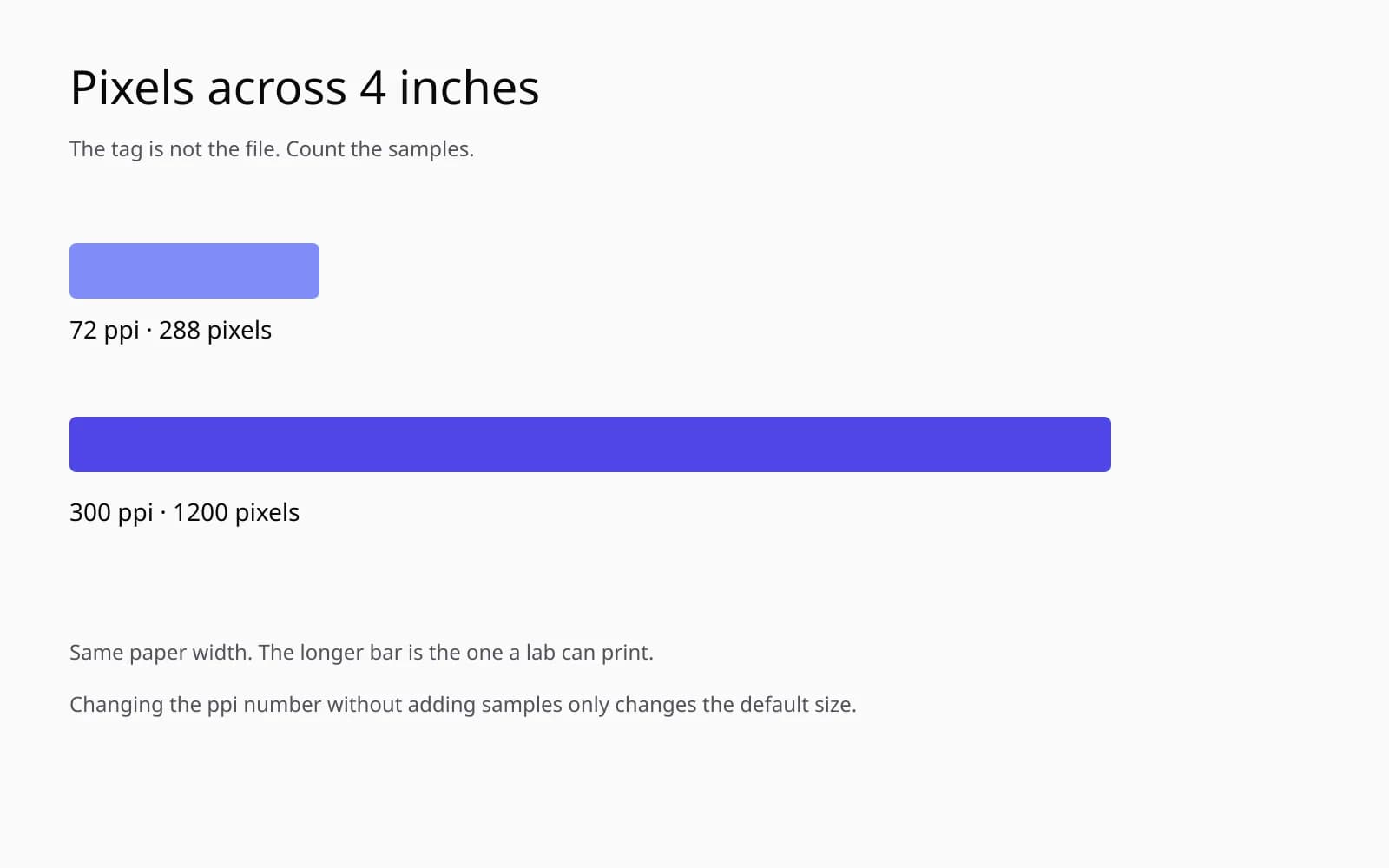
The sample on this page is generated. Flat colors, a teal panel, a sun, a round head, edges left clean on purpose. It is not her father and not a scan. I put it here because clean edges are what people picture when they hear a big resolution number. The sample is clean because it was drawn that way, with almost no pixels wasted on a slope. Her father's button is a slope. No sticker on a scanner turns a slope into the sample. If you want the sample's kind of edge you need a drawing, or a sharper photograph than the one the drugstore printed in 1978.
The nephew's lab ticket, a week later
The nephew wrote to the lab and, to his credit, used the script. The lab asked for 300 pixels per inch at 8 by 10. An 8 by 10 crop of a 4 by 6 is not the whole frame. We cropped the 600 scan to the father and a bit of the truck, 2000 by 2500 pixels, and placed that in an 8 by 10 with a margin rather than blowing it to the edges. 2000 pixels across 8 inches is 250 per inch. The lab's 300 was a preference. I sent a proof at the real size. The softness matched the print she had approved on the table. They printed it. Nobody quoted 4800 at the counter. I am taking that as the definition sticking.
She still wants the negative. If it appears, the conversation changes. A negative can hold sharpness this paper never received, and we would scan that, and the pixel grid would finally be talking about him instead of about a reprint. Until then, what is a picture resolution, for this drawer, is a grid we can count, a mapping we can divide, and a softness we refuse to blame on the wrong machine.
Questions that come up after the file is open
The file is 1200 by 1800 and the print is 4 by 6. Is that 300?
Yes, as a mapping. 1200 divided by 4 inches is 300, and 1800 divided by 6 is 300. That means the file sampled the print at 300 per inch. It does not mean the man's face is sharp. This print was soft before the scanner touched it.
The scanner box says 4800 dpi. Did we do it wrong at 1200 by 1800?
The box is the machine's maximum sampling rate, not a grade for your picture. A 4800 scan of this 4 by 6 would be enormous and still soft, with more paper fiber. We proved it on a button crop. The fiber got clearer. The button hole did not.
Can an upscaler make the soft print sharp?
It can make a sharper-looking stranger. On a deliberately tiny scan it drew a crisper eye that is not the eye on the paper. I will not trade her father's face for a number. The ceiling is the print, or a negative if one still exists.
So which number should she say when someone asks the resolution?
Pixel dimensions first, 1200 by 1800, or the 600 scan at 2400 by 3600 if that is the file she keeps. Then the inches she plans to print. Sharpness is a third sentence, and on this portrait the third sentence is: the drugstore print is soft, and the scan told the truth.