Blur · July 18, 2026
How to sharpen a blurry picture of a missed bird
How to sharpen a blurry picture of a bird on a wire when autofocus missed. Sharpen will not move the focal plane.
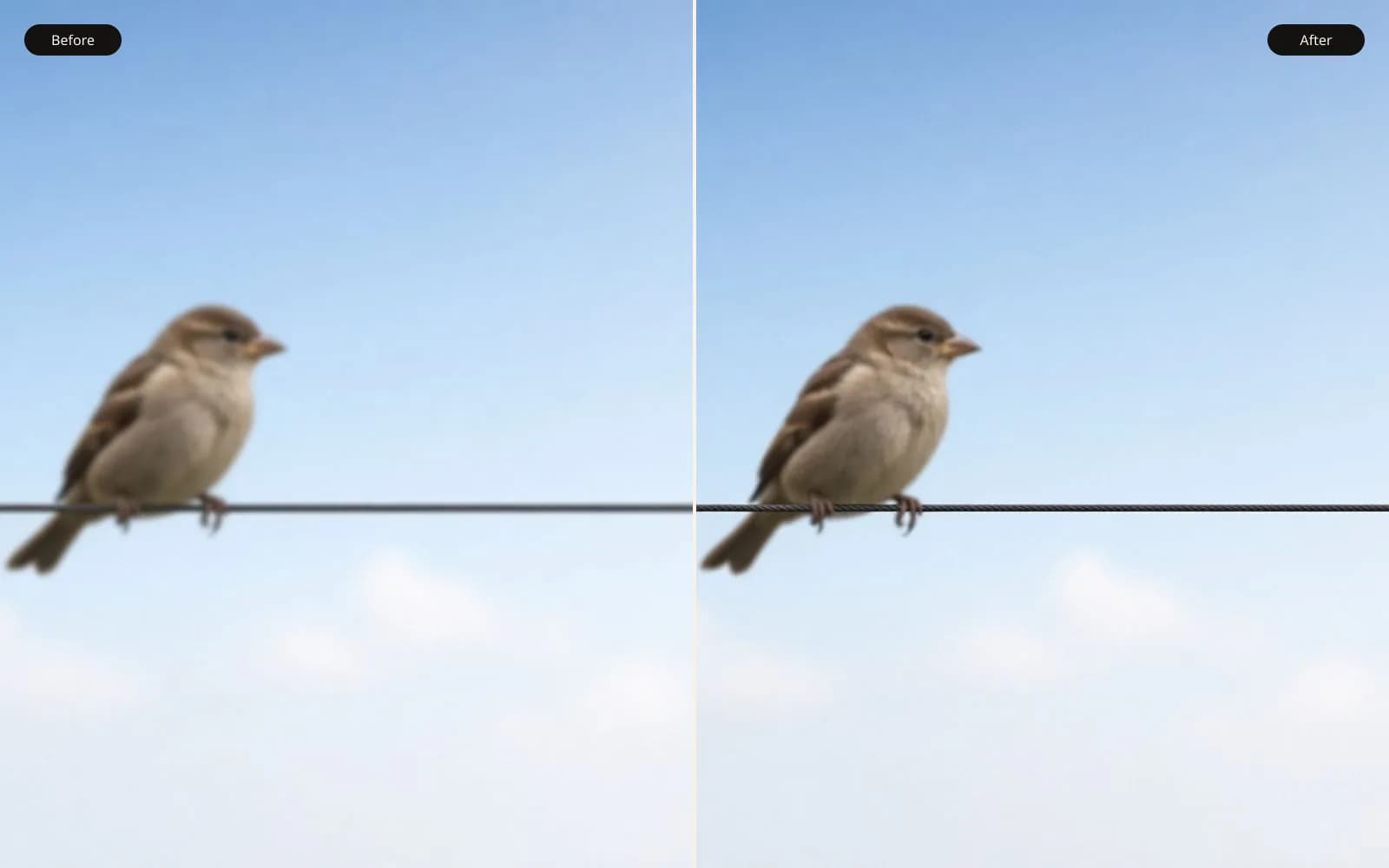
A missed bird is a small subject in a large soft field. Sharpen the blurry picture on a crop of the bird, not on the whole sky.
The file is a bird on a wire, and the search that brought it to me was how to sharpen a blurry picture. I want the short answer in the first minute of looking, before anyone opens a slider. The wire is in focus. The bird is not. Sharpening will not move the focal plane from the wire onto the bird. I tried anyway, because the person who shot it had already tried, and they wanted the failure described in pixels rather than in a shrug.
The camera wrote a 6000 by 4000 JPEG. The bird sits high in the frame, small, against a bright sky. I cropped a working rectangle 420 by 280 around the bird and the wire so I would stop judging a tiny subject inside a huge file of sky. Inside that crop the bird's body, beak to tail, is 90 pixels. The body height, back to belly, is 46 pixels. The wire crosses in front of the feet, slightly closer to the camera than the perch the bird meant to offer.
TL;DR. Autofocus chose the wire. The wire's edge rises from dark metal to sky in about 2 pixels. The bird's back rises from feather to sky in about 9. That gap is the miss. An unsharp mask did not close it. High amount split the beak into two beaks and haloed the wire. A deblur pass tightened a wing bar by a pixel or two and never produced an eye, because the eye sat inside the blur. I printed small, kept the original crop beside the attempt, and stopped calling outline a repair.
The edge test that diagnosed it
I did not start with a slider. I started with a one-pixel-wide sample across two edges, read as numbers, because the picture was flattering me at fit-to-window.
Across the wire, the luminance went from the sky's high value to the wire's dark value and back out again inside a span of about 2 pixels on each side. The core of the wire was dark for 1 pixel and almost dark for the neighbors. At the bird's back, the same kind of step took about 9 pixels to leave the feather tone and arrive at the sky. Along the beak, which is a thinner dark shape against the sky, the step was about 7 pixels and there was no clean core. The beak is a smudge with a direction.
A focused edge and a missed edge in the same frame are a gift. Most blur arguments are about a whole file that is soft, and you can debate camera shake versus focus versus a dirty window. Here the wire is the control. The lens could resolve a thin object that morning. It resolved the object in front of the bird. The bird is behind that plane.
I also looked at the feet, which wrap the wire. The toes on the near side are closer to the wire's sharpness. The toes on the far side melt into the belly. That is a depth gradient, not a smear from camera shake. Shake would have dragged the wire too. The wire is not dragged. I have talked myself into "maybe a little shake" on other files and then found the highlights doubled. They are not doubled here. One wire. One soft bird.
The eye, if I am honest about the word, is not in the crop. There is a darker region on the head about 8 pixels across, and inside it there is no smaller dark center I can mark twice and hit the same pixel. The blur disk is larger than the eye. A disk that big does not contain a hidden pupil waiting for contrast. It contains an average.
What sharpen actually did
The mask that split the beak
The first attempt was an unsharp mask, because that is the tool the name "sharpen" points at. I set radius 1.5, amount 150, threshold 0, which is a recipe I have used on a slightly soft but focused feather and liked. It assumes the blur is on the order of a pixel or two. This blur is on the order of 9.
The result looked crisper at a glance and worse at 100 percent. The beak, a single soft wedge, became two dark ridges with a light gap between them. The mask had found the slopes on both sides of the smear and outlined each slope. Two outlines read as two beaks. The wing bar, which had been a gentle lighter streak, became a white string with a dark border, and the string was not in the same place as the streak's center. I had moved the apparent edge. That is the opposite of a repair.
The wire, already sharp, grew a bright halo on the sky side about 2 pixels wide. Against a flat sky a halo is a drawn line. At arm's length on a large monitor it looked like a second, thinner wire. I have sold that look as "definition" before. On a wire it is a cartoon.
Threshold 0 was part of the mistake. It let the mask act on the sky, which was not perfectly smooth, and it speckled a fine grain into an area that had been quiet. A threshold would have spared some of the sky and would not have put the eye back. I am not going to pretend a threshold was the missed trick. The radius was aimed at the wrong defect.
A radius matched to the blur, which was worse
I tried radius 8, closer to the 9-pixel transition, amount 80. This is the version that looks "creative" in a thumbnail and awful in a print. The bird became a crunchy ghost. Broad halos sat around the whole body, a light band outside and a dark band inside, so the bird looked cut out and stuck on the sky. Background twigs that I had not noticed, themselves a little soft, woke up as dirty outlines. The double beak merged into one thicker beak that was sharper and in the wrong place, shifted toward the light side by a few pixels.
Sharpening is contrast at an edge. It is not a move of the focal plane. A larger radius just decides the edge using a wider neighborhood, which on a blur this size means the neighborhood is mostly blur. The arithmetic of unsharp mask is a blur subtracted from the original, scaled, and added back. If the original is already a blur, you are outlining a blur. I knew that and I still wanted the radius experiment in the folder, named mask-radius-8-rejected, so I would not remember it as "almost."
There is a general note on masks versus real edges in how to sharpen an image. The bird is the case where the mask is the wrong family of tool, not the wrong setting inside the right family.
Deblur, and the eye that did not return
I ran the crop through the unblur tool next, because deblur is the tool that at least admits the defect is a spread. The tool returns a 2× file. I have fooled myself with that before, calling a resample a focus pull. This time I made a plain 2× upscale of the same crop and set it beside the deblur result, same size, so any "clarity" that both files shared could be blamed on the extra pixels.
The wing bar is the one place I will defend a change. In the original it is a soft light streak about 4 pixels wide with no hard side. In the plain 2× it is a wider soft streak. In the deblur it collapses toward a single lighter core with a narrower transition, maybe 2 output pixels tighter than the plain 2×. The direction of the bar still matches the wing. I did not gain barbs. I gained a slightly more decided streak. That is a small, real improvement and it is not a bird.
The head did not cooperate. The dark region stayed a dark region. No pupil appeared. No highlight in the eye appeared. A later attempt, stronger in spirit because I had fed it the already masked file by mistake, painted a round eye with a catchlight. The catchlight was a point I could not find in the 9-pixel smear. I rejected that file in the same hour. The mistake was feeding it the mask output. Outlines are edges, and a deblur model trusts edges. I had handed it a drawing of a beak and it finished the drawing.
The blurry photo tool is the comparison I used for that rejection, original crop against the attempt, slider on the head. If you only park the slider on the wing bar you will accept the file. The head is the region that vetoes. I wrote "veto on the head" in the filename of the rejected export so a thumbnail browser would say it without my opening the file.
A longer argument about whether a soft file can come back at all sits in how to deblur a picture and in how to fix blurry photos. This wire is my concrete limit. Some blur is a spread of a real edge, and a careful pass can tighten it. Some blur is the absence of the edge, and no pass has a place to put it.
A table of the attempts
I measured the back-to-sky transition after each attempt, in output pixels, then divided by the scale so I could compare to the original's 9. This is approximate. Edges are not rulers. It was still enough to stop me from calling a halo a shorter transition.
| Attempt | Scale | Beak | Wire | Back-to-sky, in source pixels | Keep |
|---|---|---|---|---|---|
| Original crop | 1× | one soft wedge | clean, 2-pixel edge | about 9 | yes, the record |
| Unsharp radius 1.5 | 1× | two ridges | halo, looks like a twin | still about 9, plus outlines | no |
| Unsharp radius 8 | 1× | one thick shifted beak | broad halo | looks shorter, is a halo | no |
| Plain 2× | 2× | soft wedge, larger | clean | about 9 | control |
| Deblur, from the original | 2× | slightly tighter wedge | mild halo | about 7 on the back, eye unchanged | maybe, wing only |
| Deblur fed the masked file | 2× | drawn beak, fake eye | double line | not a measurement I trust | no |
The "maybe" row is the one I almost over-sold. A transition that moves from 9 to 7 is a nudge. It is not a focused bird. I told the photographer the nudge in those numbers. They had been ready to hear "fixed" because the thumbnail looked awake.
The generated sample on this note is a soft scene: a smile that survives as a shape, a sun that survives as a disk, bars that have melted into the frame. I use it to show what a blur disk keeps and what it spends. It is not the bird. The bird's wire would be the one hard line in a frame otherwise this soft, and that contrast is the whole diagnosis.
What the numbers imply for a print
The crop is 420 by 280. Printed at 300 ppi it is 1.4 by 0.9 inches. That is a detail crop, not a page. Printed at 150 ppi it is still under 3 inches wide. The bird, 90 pixels long, is 90 divided by 150, which is 0.6 inches. At that size the 9-pixel blur disk is 9 divided by 150, which is 0.06 inches, a bit over a millimeter and a half. Viewed at arm's length, a soft bird that small still reads as a bird on a wire. Viewed as an 8-inch-wide crop, the same disk is obvious and the missing eye becomes the subject.
I printed the original crop at 3 inches wide on a matte proof, about 140 ppi. It looked like a field note. The wire was a wire. The bird was soft and still the right bird: posture, the direction of the beak, the wing bar as a tone, the feet on the near side sharper than the breast. I printed the radius-8 mask at the same size. The halo around the body looked like a cutout against the paper white of the sky, and the beak was a mark I would not sign. Seeing it in ink ended an argument I was still having on the monitor, where backlight makes halos look like sparkle.
The deblur 2×, printed at the same 3 inches, was slightly more legible in the wing and slightly more processed in the sky. I gave it to the photographer as a second proof labeled "wing a little tighter, eye not recovered." I did not give them an unlabeled large file. Unlabeled large files become the memory.
Checks I now run before any sharpen on a small subject
These are on a card in the bird folder. They would have saved the beak.
- Find one edge in the frame that is actually sharp. If you cannot, say so, and do not invent a control.
- Count the transition of the sharp edge and the transition of the subject in pixels. If the subject is several times wider, the plane is wrong and a mask will outline it.
- Look for a depth gradient, near toes against far breast, before you call it shake.
- Judge the smallest feature you hope to recover. If it is smaller than the blur disk, stop expecting it.
- Make a plain resample at the same scale as any deblur that also resamples. Do not credit the resample to the deblur.
- Never feed a masked file into a second pass. Outlines become structure.
- Pro the reject at the size you mean to show. Halos that look like sparkle on a screen look like stickers on paper.
The card is specific because "be careful with sharpening" is how the double beak happened. Careful is not a radius.
The photograph I should have praised first
The wire shot is a good photograph of a miss, which is an unkind thing to say and still true. The bird's posture is intact. The feet gripping, the tail angle, the beak pointed down-left, all of that survives a 9-pixel blur because those facts are larger than 9 pixels. A 90-pixel bird can tell you the pose and not tell you the eye. I spent the first reply on the eye, because that was the request, and I buried the pose. The photographer's actual picture was the pose against a hard wire. My job was to avoid wrecking it in the name of feathers.
I also looked at the rest of the 6000-pixel frame for a second bird. There was one, lower, even smaller, about 40 pixels, and softer. I did not open a sharpen on it. At 40 pixels with a worse miss, a mask would have drawn a bird-shaped ring. I cropped it only to show them that this frame contains one bird we can print small and another we can only mention.
EXIF claimed a 400 millimeter equivalent and a shutter of 1/1600, which is fast enough that shake was unlikely, and it matches the wire. I do not use the focus-distance tag. On this body I have seen it stuck on a previous lens. The edge widths are the measurement. The tag is a rumor that happened to agree.
Where I stopped
I stopped when the next pass would have had to draw an eye to look finished. Finished was the request. Finished was also the lie. The delivered folder has the original JPEG, the 420 by 280 crop, the 3-inch proof note, the deblur file labeled as a wing nudge, and the rejected masks. It does not have a large sharp bird.
If you are holding a blurry picture and the blur is a little motion on a focused subject, a careful deblur is a fair test, and the checks above will tell you if the test worked. If you are holding this picture, a sharp wire and a soft bird, the test has already answered you before the slider moves. The plane is on the wire. Sharpen lives on the plane it is given. It does not get to choose a farther one.
I told them to keep shooting, which is the only real fix for a miss this size, and I meant the next bird, not a longer afternoon on this file. This file has given what it has. The wire is crisp. The bird is a true, soft shape on the right side of the sky. That is enough for a field note and not enough for a feather photo, and no radius changes the category.
Questions that come up after the file is open
Will sharpening a missed-focus bird put the eye back?
No. Sharpening raises contrast at edges that are already in the file. If the eye is smaller than the blur disk, there is no eye edge to raise. The focal plane stays where the camera left it.
Why did the wire look worse after I sharpened the bird?
The wire was the sharp thing. A mask treats that edge as enthusiastically as the soft bird, and a thin wire grows a halo or a twin line against the sky.
Is unblur the same as an unsharp mask?
No. A mask outlines. A deblur pass tries to tighten a spread. On this file it helped a wing bar slightly and still could not invent an eye the blur had erased.
How big should I print a soft bird?
Small enough that the blur disk stays under the size where a viewer expects feathers. A sharp wrong beak is a worse print than a small soft one.