Blur · August 18, 2026
Can AI unblur an image without changing the eyes
Can AI unblur an image, or does it predict a likely sharp relative? I keep the file only if the eyes still match.
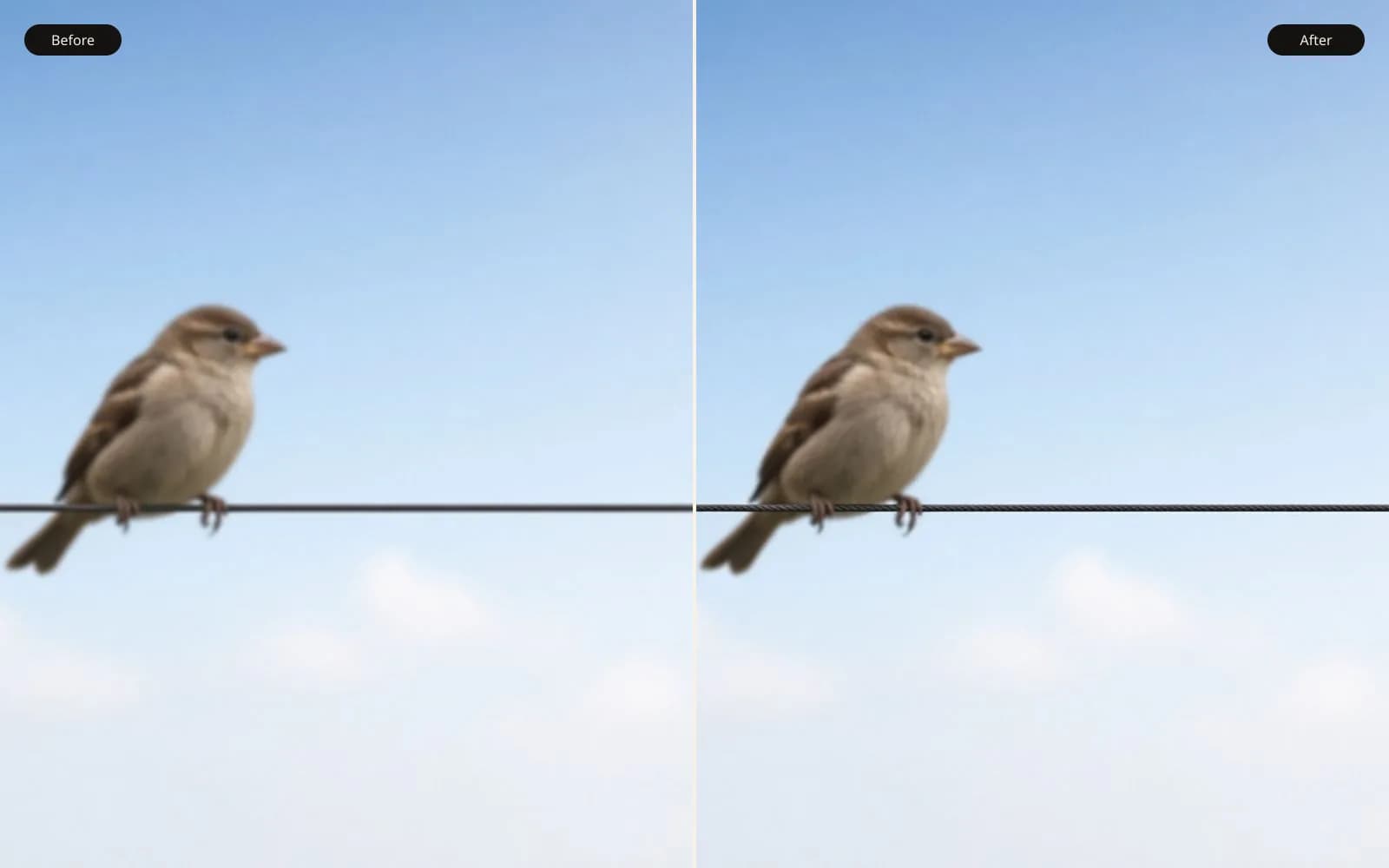
The eyes are the test, not the slogan. Unblur the image and stop if the person is no longer the person.
The question I had to answer, in those words, was can ai unblur an image. The honest answer is that the model does not unmix the exposure and hand you back the photons. It predicts a sharp photograph that is a likely relative of the blurry input. Likely is doing all the work in that sentence. I keep the prediction only when the eyes still belong to the same person, checked at a size where a lie cannot hide in a thumbnail.
TL;DR. An unblur model proposes one sharp story that fits the blurry file and fits a habit learned from other pictures. It is not a retrieval of the latent frame. I test the story on the eyes: catchlight direction, irregular iris, and a mark I can name. A sofa snapshot with eyes 38 pixels wide grew a centered catchlight the lamp does not support, and I rejected it. A doorway frame with eyes 90 pixels wide and a 6 pixel shake kept a darker wedge in the iris and the correct catchlight, and I kept it. The tool lets me see both files. It does not bless either of them.
What the model is emitting
I am not going to draw the mixture board again. A blurred pixel is a sum, and more than one sharp scene can share a sum. That argument is is it possible to unblur a photo. The model lives one step downstream of it. Faced with a file that fits many sharp scenes, the model picks one. The pick is whatever sharp image was typical, in its training, for blurry inputs that looked like yours.
Typical is a useful guess and a dangerous one. Typical eyes are level, similarly lit, with round catchlights and lashes of a popular length. Typical teeth are even. If your blurry file still contains a crooked catchlight and a chipped tooth, a careful model will keep them, because they are evidence. If the blur has already averaged those away, the model will fill in the typical version, because the typical version is what it has. The output can be sharp and be a cousin of the person.
Can ai unblur an image, then, in the sense of "produce a sharper file"? Yes, it can produce one. In the sense of "return the picture I would have had at a faster shutter"? Only sometimes, and the sometimes is an empirical test, not a property of the word AI. I do not grade the file by how crisp the hair became. Hair is where these models are fluent. I grade it by the eyes, where fluency becomes a different face.
Upscaling is a neighbor of this and not the same job. An upscaler proposes extra samples between the ones you have, and the long version of that mechanism is how AI upscaling works. An unblur model proposes a sharp image that the blurry one could be a damaged copy of, often at the same pixel size or close to it. Both are predictions. Both can invent. Mixing the buttons, "make it bigger and sharper" in one gesture, stacks two predictions. I do not stack them until the eyes have survived the first one. The upscaler is for size. The unblur tool is for the mixture. I say tool without enthusiasm on purpose. It is a place the file goes and a place a result comes back. The result is the thing I test, not a prize.
The test I actually run
I open the original and the prediction at the same zoom, on the eye, and I look in an order I wrote down so I cannot start with the pleasant part.
First the catchlight. It is a picture of the light source, sitting in the cornea. If the lamp is to frame-left, the catchlight is to frame-left of the pupil's center, in both eyes, with the head-on caveats a turn of the face requires. A model that centers a round dot in each pupil has installed a studio light that was not in the room. I reject on that alone.
Second, the iris boundary and the pigment. A real iris is not a coin. The limbal ring is uneven. Pigment has a wedge, a freckle, a sector that is darker. If the prediction has turned the iris into a radial stamp, the same fibers repeated, I reject. If a wedge I can see in the original, even as a three-pixel smudge, has moved or vanished, I reject.
Third, anything with a name. A chip in a tooth. A red vein in the white of the eye. A scar at the brow. These are not aesthetic. They are checks. A model that heals them has decided the person should be easier to look at. I did not ask for that.
Fourth, the lashes, last, because lashes are where I get fooled. Even, separated, dark lashes look like quality. They are also the easiest thing to draw. I only trust a lash that was already a specific defect: one longer spike, a gap, a clump. If that specific defect survives, good. If the lid has become a uniform comb, I do not care that it looks groomed.
I do this on one eye, then the other. Models sometimes tidy one eye more than the other. The less tidy eye is not the one I should judge if I am trying to be kind to the tool. I judge both.
The sofa file I rejected
niece-sofa-blur.jpg is a phone JPEG from 2016, 3264 by 2448, 1.6 megabytes. Indoor evening, a floor lamp with a pale shade at frame-left, a sofa, a face that is not large. I measured the visible eye at about 38 pixels wide. That is a small eye. Thirty-eight pixels have to hold the lid, the white, the iris, and the catchlight. There is not a lot of iris left once the blur has had a turn. The blur itself is a mild mix of motion and the phone's own processing. I am not going to pretend I extracted a kernel. The file is what the album had.
The prediction is niece-sofa-pred.jpg, same 3264 by 2448, 2.1 megabytes. At thumbnail size it is the better photograph. The face is awake. The lamp shade is a cleaner trapezoid, which I will give the model, because the shade is a simple plane and the original already showed its edges. Simple geometry is where a prediction earns its keep.
At 100 percent on the eyes it fails the list in order.
The catchlight is a round dot near the center of each pupil. The lamp is frame-left. In the original, the catchlight is a faint smear biased to frame-left, consistent with that shade. The prediction has moved it. I do not need a diagram. I toggle, and the dot jumps. A jumped catchlight is a jumped light source.
The iris is a repeated texture, brown, plausible, and the same pattern in both eyes to a degree the original does not support. The original irises are muddy. Muddy is not a wedge I can defend. I will not invent a wedge that I cannot see and then accuse the model of deleting it. On pigment, this file is too small for me to claim a specific sector. I claim the catchlight and the tooth.
The tooth: a sharper frame from the same hour, niece-sofa-lamp.jpg, 3264 by 2448, 2.4 megabytes, shot with the lamp closer and the face larger, shows a small chip on the left central incisor. The blurry file, if I squint, has a unevenness on that tooth and does not prove the chip. The prediction fills the tooth into a smooth edge. The lamp frame is not the same expression, and it is the same mouth. I rejected the prediction. A smooth tooth is the typical tooth. This person does not have the typical tooth.
Lashes on the prediction are a comb. I noted it and did not need it. The catchlight and the tooth were enough. The file stays in experiments/rejected/. The album keeps niece-sofa-blur.jpg and, where the expression allows, niece-sofa-lamp.jpg. I would rather print the muddy original small than print a centered catchlight big.
This is the failure mode I expect when the eye is under about 40 pixels and the blur has already eaten the light. The model is not misbehaving relative to its job. Its job is a likely sharp relative. A likely child on a sofa has even teeth and tidy lights. The job and the person diverge, and the divergence is the whole reason for the test.
The doorway file I kept
brother-doorway.jpg is 4000 by 3000, 3.8 megabytes, a door open to daylight, face in the shade of the hall, 1/30 second. A hinge screw that should be a point is a short streak of about 6 pixels, mostly vertical. The eyes are about 90 pixels wide. Ninety is not huge. It is enough to see a sector of pigment if it is really there.
It is there. In the original, the left iris has a darker wedge toward the lower left, soft because of the shake, and still a wedge rather than a general darkness. The catchlight is frame-left, a small rectangle broken by the door's glass bar, not a disk. I wrote both facts in brother-doorway.txt before I ran anything. Writing first is how I keep myself from "seeing" the wedge only after the model draws one.
The prediction is brother-doorway-pred.jpg, 4000 by 3000, 4.6 megabytes. I looked at the hinge first, not the face, to see whether the 6 pixel streak had tightened without a double edge. It had tightened. A faint echo remained under the screw. Acceptable on metal. Then the eyes, in the order above.
The catchlight stayed frame-left. It got a little cleaner and it did not become a centered disk. The glass bar is still a gap in the highlight. Good.
The wedge stayed in the lower left of that iris. It is more legible than in the original, which is the risky kind of "more," so I compared it with brother-doorway-02.jpg, shot at 1/125 a few seconds later, a different expression, same person, sharper. The wedge is in the same sector. The prediction did not move it up or turn it into a ring. Good.
A red vessel in the white of the other eye, faint in the original, is still faint in the prediction. It was not healed. Good.
Lashes: one longer spike on the upper lid, which is a faint dark tip in the original, remains one spike. The rest of the lid is a bit more separated than I can swear to. I did not reject on a bit. I would have rejected on a comb.
The wedge is the standard, not the hair
I am aware the hair in the prediction is nicer than the hair in the original. Strands resolved, a little more of them than the 6 pixel shake can justify. I do not use the hair as a reason to keep the file. Hair is fluent. The wedge is not fluent. A model that wanted to impress me would spend its effort on the hair and the lashes, and it did. The reason the file is allowed to exist in the delivery folder is the wedge and the catchlight and the vessel, which are boring and specific.
I delivered brother-doorway-pred.jpg for that expression, and I delivered frame 02 for the later expression. I did not replace frame 02 with a prediction. Frame 02 does not need one. Using a model on a sharp file is how the wedge gets "improved" into a different wedge. I ran that mistake on a copy, brother-doorway-02-pred.jpg, and the wedge got smoother and slightly smaller. Rejected, deleted from delivery, kept in rejected so I remember. The test is not only for blurry inputs. It is for any file the model has touched.
The eye test, in the order I refuse to shuffle:
- The catchlight stays on the side the room lamp explains.
- Iris pigment keeps any wedge I wrote down before the model ran.
- A named mark, a tooth or a vessel, is not healed.
- A specific lash defect may survive. A uniform comb does not count as evidence.
| File | Eye width | Shake clue | Catchlight | Named mark | Decision |
|---|---|---|---|---|---|
| niece-sofa-blur.jpg | ~38 px | Mild, mixed | Smear, frame-left | Uneven tooth | Input |
| niece-sofa-pred.jpg | ~38 px | Cleaned | Centered disk | Tooth filled | Rejected |
| niece-sofa-lamp.jpg | larger face | Sharp enough | Frame-left, shade-shaped | Chip visible | Use instead |
| brother-doorway.jpg | ~90 px | Hinge ~6 px | Frame-left rectangle | Soft wedge | Input |
| brother-doorway-pred.jpg | ~90 px | Hinge tighter | Still frame-left | Wedge same sector | Kept |
| brother-doorway-02.jpg | ~90 px | Sharp, 1/125 | Frame-left | Wedge confirms | Kept, no model |
What the tool is for, and what it is not
I ran both predictions on the unblur tool, original beside result, and I dragged across one eye at a time. That is the entire feature I care about. A full-screen after picture of the sofa file would have won. The face is awake, the lamp is clean, and I would have noticed the tooth only if I were already suspicious. The side-by-side view makes the catchlight jump obvious. I do not need a score. I need the jump.
The tool does not know where the lamp was. It does not know about the chip. It will not refuse a file on my behalf. If I upload the sofa JPEG and download the prediction and skip the eye, the tool has performed correctly and I have not. I am writing that because it is easy to talk about a tool as if the tool contained the test. The test is the toggle, done by a person who has looked at the room.
I also do not upload a file and then throw away the original because the prediction "replaced" it. The sofa original is the photograph. The prediction is a rejected relative. The doorway prediction is a relative I accepted for one expression, stored under a name that says pred, next to the JPEG it came from. Names are part of the test. A file called brother-doorway-sharp-final.jpg would have lost the thread. brother-doorway-pred.jpg cannot be mistaken for the camera file in a hurry.
Letters are a harsher test than eyes when you have them, because a letter is right or it is not. Eyes have more room to be "close." I use letters when the picture is a sign, and that method is how to deblur a picture. I use eyes when the picture is a person. I do not use a general impression of clarity for either.
What I will say when someone asks again
I will say the model can propose a sharp relative, and that I have kept one when the eyes were large enough and the shake was short and the marks survived. I will say I have rejected one when the eyes were a few dozen pixels and the proposal installed a light that was not in the room.
I will not say the AI recovered the image. Recovery is the wrong word. It implies the sharp frame was in the file, hidden. The sharp frame was one of several stories consistent with a damaged measurement, and the model told one story fluently. Fluency is not identity. The catchlight is identity. The wedge is identity. The chip in the tooth is identity. Everything else is a haircut.
If those checks cannot be run, because the face is tiny or the only copy is the prediction and the original was overwritten, I do not have an unblur. I have a new portrait that happens to share a sofa with the old one. I do not put that portrait in the album. The question can ai unblur an image has a practical answer only after the eyes, and the answer is allowed to be no.
Questions that come up after the file is open
Does an AI unblur recover the original sharp photo?
No. It predicts a sharp image that could plausibly have produced the blurry one, given other photographs it has learned from, and several sharp images can share one blurry result. The model returns one of them, not a receipt.
What do I look for in the eyes?
Catchlight position, an irregular iris, and any mark I can name, such as a chip in a tooth or a darker wedge in the iris. If the catchlight moves to the center of the pupil and the mark vanishes, I reject the file even when the skin looks clean.
When did I accept a model result?
On a doorway portrait where the eyes were about 90 pixels wide and the shake was only about 6 pixels. The darker wedge in the iris stayed put, and the catchlight stayed on the side the door glass explains. A sofa snapshot with 38 pixel eyes failed the same test.
Does the tool prove the prediction is true?
No. The tool puts the original and the prediction on one screen so I can do the eye test, and it does not certify identity. A slider is a way to look, not a verdict.